
An ACL injury is a tear or sprain of the anterior cruciate ligament, one of the main stabilising ligaments inside the knee. If you felt a pop during sport, developed swelling within a few hours, or your knee now gives way while turning, get it assessed early. ACL treatment depends on the tear severity, knee instability, activity level and whether the meniscus or other ligaments are also injured.
What is the ACL?
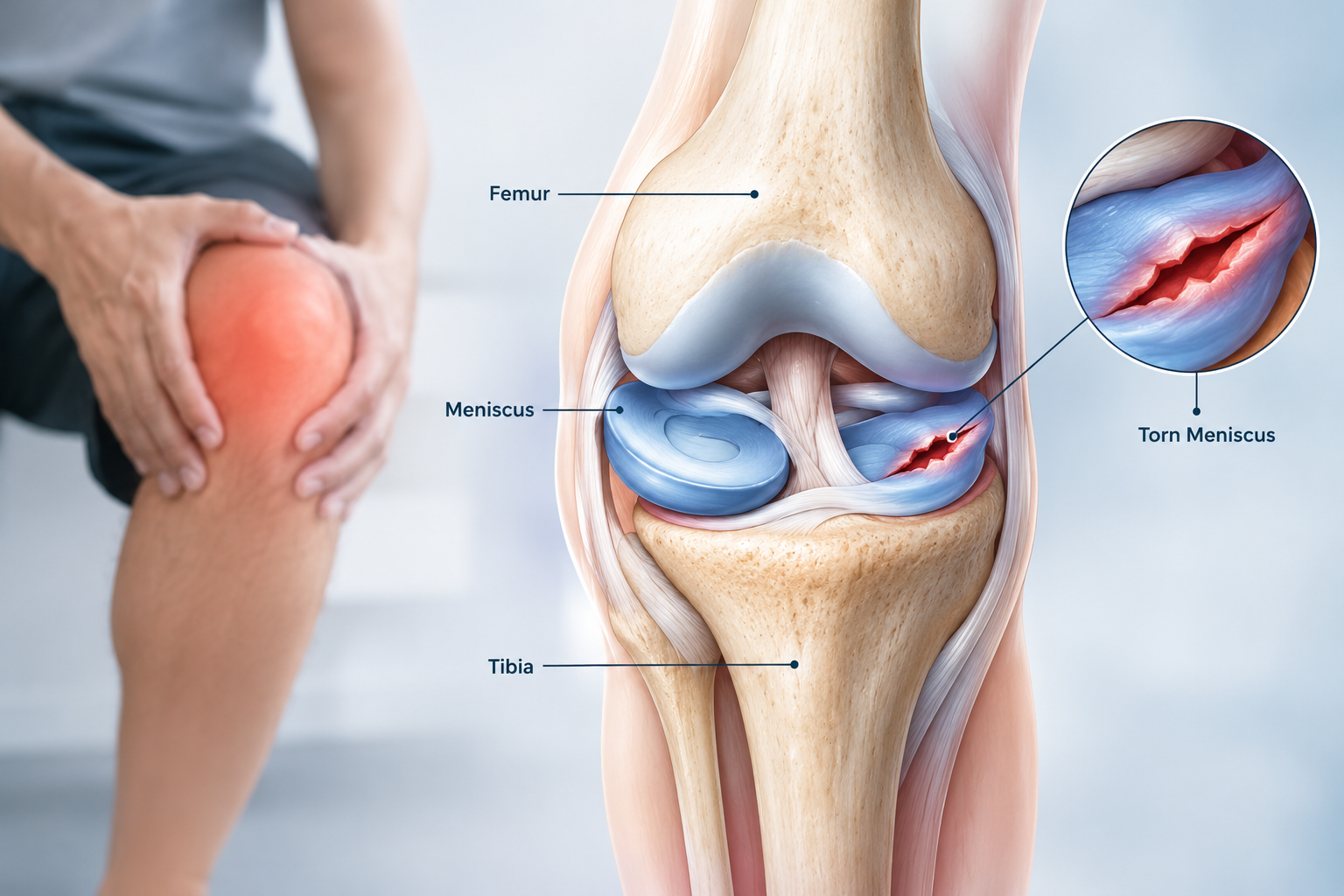
The knee is one of the largest joints in the body. It is formed where the thigh bone, called the femur, meets the leg bone, called the tibia, with the kneecap or patella in front.
The ACL, or anterior cruciate ligament, runs inside the knee joint. Its main job is to stop the tibia from sliding too far forward in relation to the femur. It also helps control rotation when you twist, pivot, land or change direction.
Why ACL injuries are common in sport
The ACL is commonly injured during sports because the ligament is heavily loaded during sudden direction changes, awkward landings and twisting movements. The injury may happen alone or along with a meniscus tear, collateral ligament injury or cartilage damage.
Football, basketball, badminton, skiing, running on uneven ground and gym movements with sudden pivoting can all cause ACL injury.
- Sudden twist while the foot is planted
- Pivoting or cutting during sport
- Awkward landing after a jump
- Direct fall or blow to the knee
- Hyperextension or forceful rotation of the knee
Main symptoms of an ACL tear
Many patients describe a clear pop at the time of injury. Swelling often develops within a few hours because bleeding can occur inside the joint.
The most important symptom after the acute pain settles is instability. The knee may feel unreliable, especially while turning, climbing stairs, running or trying to return to sport.
- A pop sensation at the moment of injury
- Swelling within a few hours
- Pain deep inside the knee
- Instability or giving-way feeling
- Difficulty returning to pivoting sports
- Locking or catching if the meniscus is also torn
How ACL injury is diagnosed
Diagnosis starts with a clinical examination. Tests such as Lachman’s test and drawer tests help assess whether the knee has abnormal forward movement or instability.
MRI confirms the extent of the ACL injury and also shows associated meniscus, cartilage or ligament damage. A standing X-ray may be advised to assess knee alignment or rule out bony injury.
- History of twist, fall, pop or sports injury
- Examination for swelling and instability
- Lachman’s and drawer tests
- MRI to confirm ACL tear and associated injuries
- Standing X-ray when alignment or bone injury needs assessment
Partial ACL tear vs complete ACL tear
A partial ACL tear means some fibres of the ligament are damaged but not all. A complete ACL tear means the ligament has lost continuity and the knee may become unstable.
The treatment decision is not based only on the MRI report. A stable partial tear in a low-demand patient may be managed without surgery, while an unstable complete tear in an active patient often needs ACL reconstruction.
Can ACL injury be treated without surgery?
Some ACL injuries can be managed with physiotherapy, activity modification, bracing and strength training. This is more likely when the tear is partial, the knee is stable and the patient does not need to return to pivoting sports.
If the knee repeatedly gives way, non-surgical care may not be enough. Repeated instability can put the meniscus and cartilage at risk over time.
- Physiotherapy to restore movement and strength
- Swelling and pain control
- Balance and neuromuscular training
- Activity modification for selected patients
- Bracing when appropriate
ACL reconstruction surgery
The standard surgical treatment for an unstable ACL tear is arthroscopic ACL reconstruction. The surgery is performed through small incisions using a camera and specialised instruments.
The torn ACL is replaced with a graft, commonly taken from the patient’s own hamstring, quadriceps tendon or bone-patellar tendon-bone graft. If a meniscus tear is present, it may be repaired or treated during the same procedure when suitable.
Recovery after ACL reconstruction
Rehabilitation starts early and is as important as the surgery itself. The aim is to reduce swelling, restore knee movement, rebuild strength and gradually return the patient to work, daily activity and sport.
Return to sport should not be rushed. The knee needs time for graft healing, muscle recovery, balance training and sport-specific control.
- Rehabilitation usually begins the same evening or next day
- Walking starts with crutches or walker support
- Early rehab focuses on swelling control and knee movement
- Strengthening continues over the next few weeks
- Driving is often considered around 6 weeks when control is safe
- Return to sports usually takes 9 to 12 months after proper testing
When should you see a specialist?
A knee injury should be reviewed early if there was a pop, rapid swelling, instability, locking or difficulty trusting the knee. These symptoms can indicate ACL tear, meniscus tear or combined injury.
Early diagnosis helps plan the right treatment and avoids repeated loading of an unstable knee.
Frequently asked questions
ACL injury means damage to the anterior cruciate ligament, a key ligament inside the knee that controls forward movement and rotation of the tibia. It may be a sprain, partial tear or complete tear.
Common symptoms include a pop at the time of injury, swelling within a few hours, pain, instability, giving-way feeling and difficulty returning to sports. Locking may suggest an associated meniscus tear.
Yes, some people can walk after an ACL tear once the first pain settles. Walking does not rule out ACL injury. Instability, swelling and giving way are more important warning signs.
No. Stable partial tears may be treated with physiotherapy and activity modification. Surgery is usually considered for unstable complete tears, repeated giving way or patients who want to return to pivoting sports.
ACL injury is confirmed with clinical examination and MRI. Lachman’s and drawer tests check instability, while MRI shows the ACL tear and associated meniscus, cartilage or ligament injuries.
ACL reconstruction is arthroscopic surgery where the torn ligament is replaced with a graft, commonly from the patient’s hamstring, quadriceps tendon or patellar tendon.
Walking begins early with support, but full recovery takes months. Driving may be possible around 6 weeks when safe, while return to pivoting sports usually takes 9 to 12 months after rehabilitation and testing.
If the knee remains unstable, repeated giving-way episodes can increase the risk of meniscus and cartilage damage. Stable low-demand knees may do well without surgery, but unstable knees should be reviewed.
Originally published on dranilraheja.com.