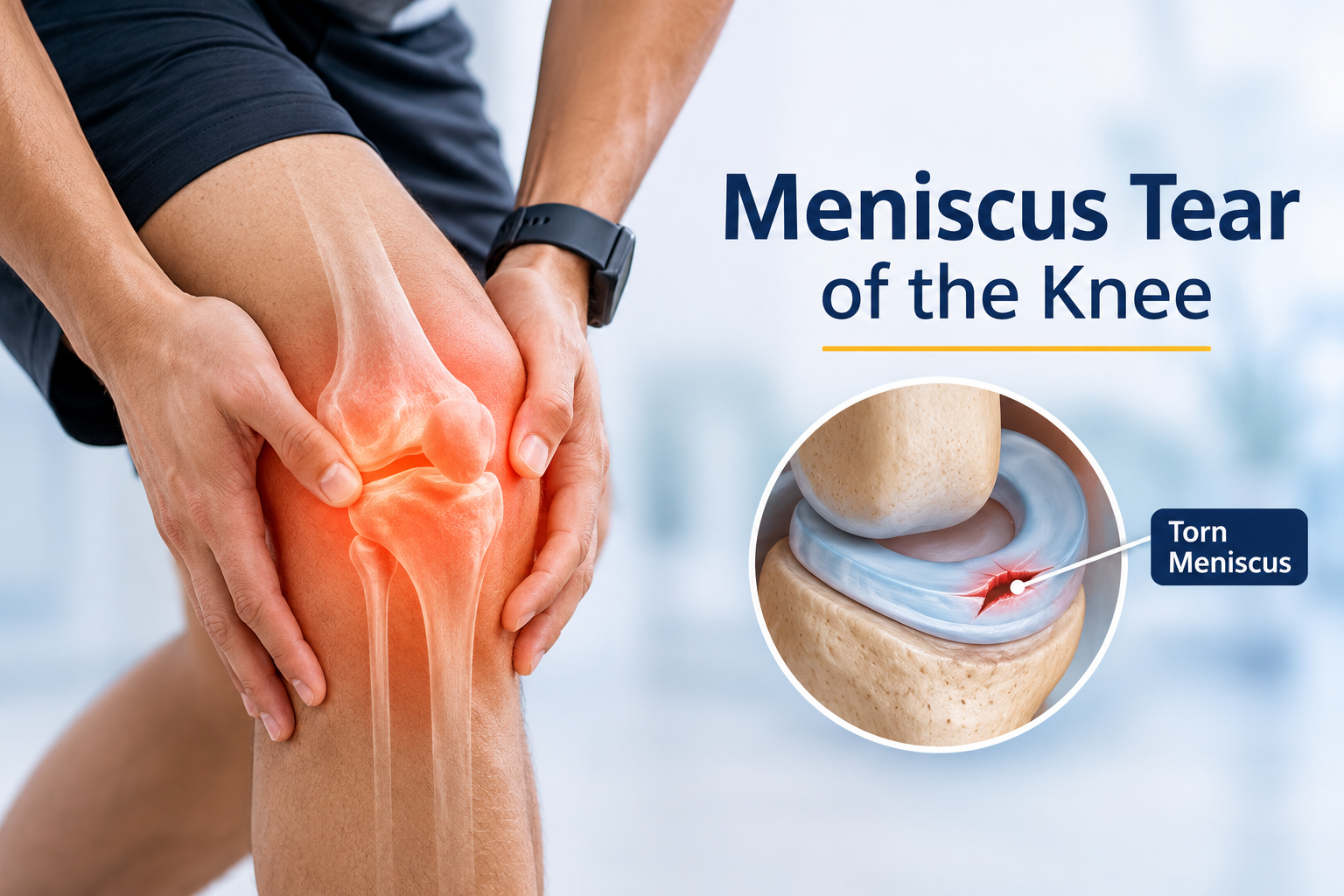
The menisci are two crescent-shaped pieces of tough cartilage that sit between the thighbone and shinbone in each knee. They act as shock absorbers, help distribute body weight and contribute to knee stability. A tear can occur during a sudden twisting injury or develop gradually with age. Symptoms and treatment vary according to the tear’s pattern, location, severity and the person’s activity level.
What Is a Meniscus Tear?
Each knee contains two menisci: an inner (medial) and an outer (lateral) crescent-shaped piece of cartilage between the thighbone (femur) and shinbone (tibia). They help distribute body weight, absorb shock and support joint stability.
A meniscus tear is damage to one of these structures. It may occur during a sudden twisting injury or develop gradually as tissue changes with age. An MRI finding does not automatically mean the tear is causing symptoms; it must be interpreted alongside the history and physical examination.
Common Causes and Risk Factors
A tear can occur when the knee twists forcefully while the foot remains planted. This is common in sports involving pivoting or sudden changes of direction, but it can also happen during deep squatting, lifting or a fall.
With age, meniscal tissue may become less flexible and more vulnerable to tearing during routine activities. A meniscus tear can also occur with other knee injuries, including an anterior cruciate ligament (ACL) injury.
- Sudden twisting or pivoting of the knee
- Deep squatting or lifting while the knee is rotated
- Sports involving rapid turns or changes of direction
- Age-related wear and reduced tissue resilience
- A fall or direct impact to the knee
Symptoms of a Meniscus Tear
Symptoms vary according to the tear’s pattern and severity. Pain may begin immediately after an injury, while swelling and stiffness can develop over the next hours or days. Degenerative tears may cause gradual or intermittent discomfort.
- Pain along the inner or outer knee joint line
- Swelling or stiffness
- Pain with twisting, squatting or deep bending
- Catching, clicking or locking sensations
- Difficulty fully straightening or bending the knee
- A feeling that the knee may give way
When Should You Seek Medical Assessment?
Arrange an assessment if knee pain, swelling or catching persists, affects walking or limits everyday activities. A knee that becomes stuck and cannot fully straighten needs prompt medical evaluation, particularly after an injury.
Seek urgent care after a significant injury if you cannot bear weight, the knee is severely swollen or deformed, or the pain is intense. A hot, red knee accompanied by fever also needs urgent assessment.
How Is a Meniscus Tear Diagnosed?
Assessment begins with a discussion of how symptoms started, which movements aggravate them and whether there have been previous knee problems. The doctor examines tenderness, swelling, range of motion and stability. Joint-line tenderness, the McMurray test and the Thessaly test may be used; combining examination findings can improve diagnostic accuracy.
X-rays do not show the meniscus itself, but they can help identify arthritis, fractures or other causes of pain. MRI is generally the preferred imaging test for an acute meniscus tear because it shows soft tissues, including the menisci, ligaments and cartilage. Imaging findings are considered together with symptoms and examination.
Non-Surgical Treatment Options
Many meniscus tears do not require immediate surgery. If symptoms are manageable and the knee is not locked, an initial plan may include modifying painful activities, managing swelling and beginning a guided rehabilitation programme.
Physiotherapy can restore movement, improve strength around the knee and hip, and support a gradual return to normal activity. Pain-relieving medicines may be considered after reviewing medical history and other medicines. Treatment should be individualised; prolonged inactivity or repeatedly pushing through sharp pain is generally unhelpful.
- Temporarily reduce activities that provoke pain, such as deep squats and pivoting
- Use an ice pack wrapped in a cloth for short periods to help manage swelling
- Follow a clinician-guided mobility and strengthening programme
- Return gradually to sports and demanding activities as function improves
When Is Meniscus Surgery Considered?
Surgery may be discussed when symptoms remain significant despite appropriate non-surgical care, when a displaced tear restricts knee movement, or when the tear has features that may be suitable for repair. The decision depends on tear pattern and location, tissue quality, activity goals, associated injuries and the overall condition of the knee.
A locked knee caused by a displaced tear needs early orthopaedic assessment. For selected acute tears that have not improved with conservative treatment, timely surgery may be considered. This does not mean every meniscus tear requires an operation.
Arthroscopic Meniscus Repair and Partial Meniscectomy
Arthroscopy is a minimally invasive procedure performed through small incisions using a camera and specialised instruments. If the tear is in a region with healing potential and the tissue is suitable, the surgeon may repair it with sutures or fixation devices. Repair aims to preserve the meniscus, but recovery is usually longer and temporary rehabilitation restrictions may be needed.
If a tear cannot be repaired, the surgeon may remove only the unstable damaged portion (partial meniscectomy), preserving as much healthy meniscal tissue as possible. The choice depends on the tear and the condition of the knee. Preserving functional meniscus is important because removing more tissue can increase pressure on the joint and may contribute to later degeneration.
Recovery and Rehabilitation
Recovery varies with the procedure and the individual. After a meniscus repair, weight-bearing and knee movement may be restricted for a period to protect healing tissue, and return to sport can take several months. After a partial meniscectomy, progress is often quicker, but swelling, strength and movement still need to recover.
Rehabilitation focuses on restoring knee motion, rebuilding quadriceps and hip strength, improving balance and gradually returning to daily activities. Follow the treating surgeon’s instructions rather than comparing recovery timelines with someone else.
Can a Meniscus Tear Be Prevented?
Not all tears can be prevented, particularly those related to age-related tissue changes. Maintaining leg strength and control, warming up before sport, using appropriate technique and increasing training intensity gradually may reduce avoidable injury risk.
- Strengthen the quadriceps, hamstrings, gluteal and core muscles
- Warm up before sports and practise controlled landing and turning
- Increase exercise duration and intensity gradually
- Avoid sudden twisting under heavy load when possible
- Allow adequate recovery between demanding sessions
Why Individualised Orthopaedic Assessment Matters
Knee pain can arise from several structures, including cartilage, ligaments, tendons and the joint lining. A meniscus tear should therefore be assessed in the context of symptoms, examination and imaging. An orthopaedic specialist can explain whether rehabilitation, further investigation or surgery is appropriate and discuss expected benefits, limitations and recovery requirements.
Frequently asked questions
Some tears, particularly those with mild symptoms or in areas with better blood supply, may improve with non-surgical care. The likelihood of healing depends on the tear’s location, pattern and tissue quality. A clinician can help determine whether rehabilitation and monitoring are appropriate.
Not always. A doctor begins with the history and physical examination. MRI is commonly used when imaging is needed and is the preferred test for acute meniscal tears, but the need for it depends on the clinical situation.
No. Many tears can initially be managed with activity modification and physiotherapy. Surgery is considered for selected tears, such as those causing persistent symptoms or mechanical restriction, when the expected benefits justify the procedure.
Meniscus repair uses sutures or fixation devices to help the torn tissue heal. Partial meniscectomy removes only the unstable damaged portion when repair is not suitable. Preserving as much functional meniscus as possible is an important surgical principle.
Recovery depends on the procedure and the individual. Meniscus repair generally requires a longer healing and rehabilitation period than partial meniscectomy. Return to work, daily activities and sports should follow the surgeon’s and physiotherapist’s guidance.
Some people can walk, while others have pain, swelling or difficulty bearing weight. Avoid activities that worsen symptoms and seek assessment if walking is difficult, the knee locks or swelling is significant.
Originally published on dranilraheja.com.