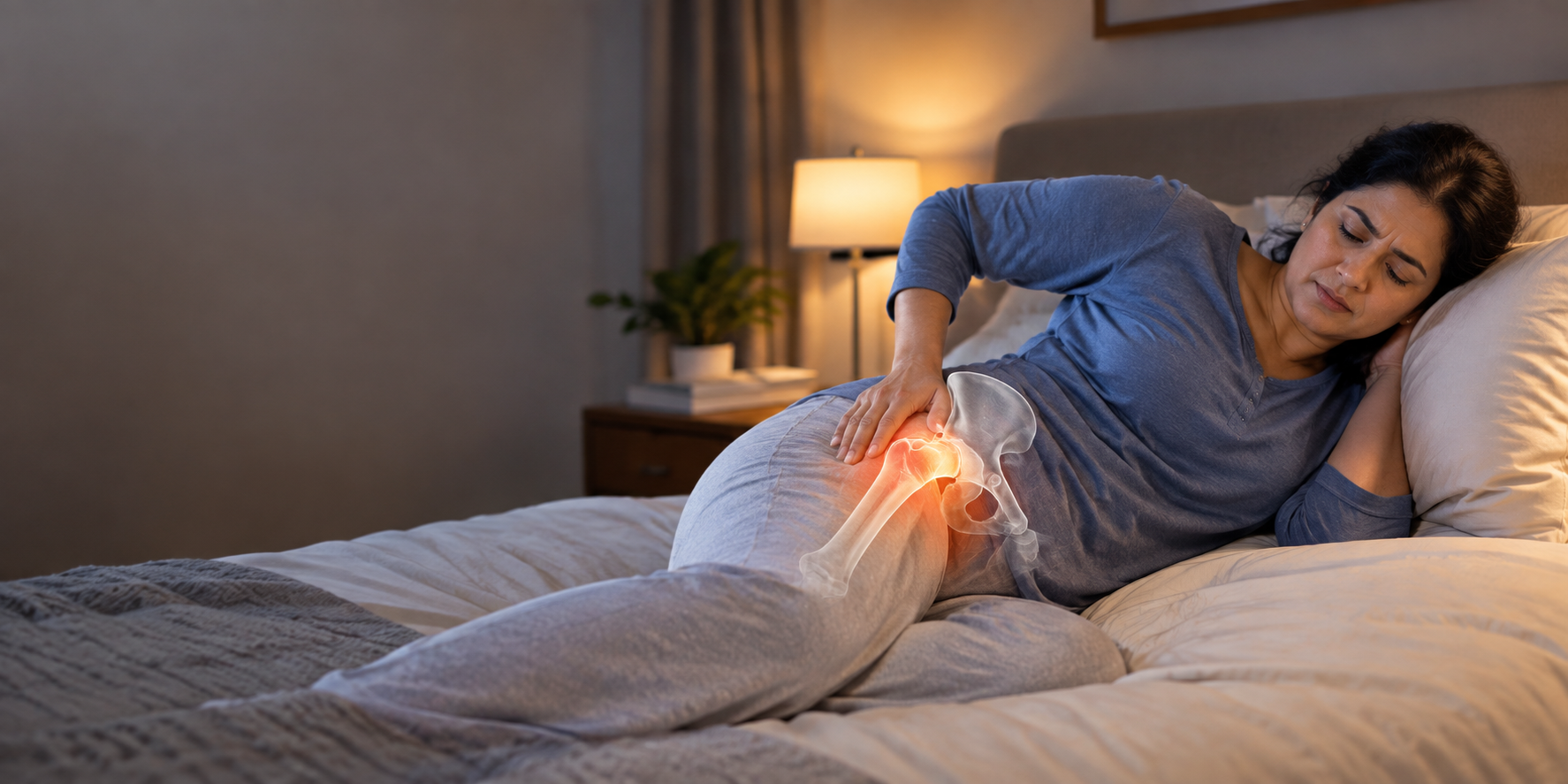
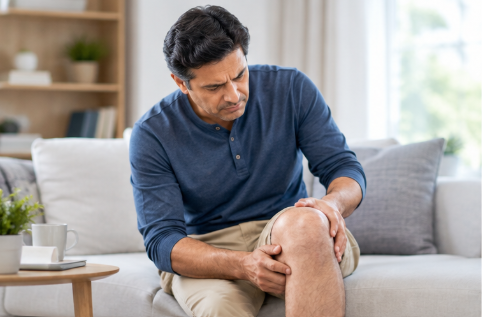
Do your knees hurt when you stand up after sitting for a long time? You may notice pain or stiffness after working at a desk, travelling, watching television or sitting through a long meeting. In some people, the discomfort lasts only a few moments and improves after walking. In others, it keeps returning or gradually becomes more difficult to ignore. Knee pain after sitting can occur for several reasons, including osteoarthritis, patellofemoral pain, reduced muscle strength and other knee conditions. Understanding the pattern of your symptoms can help determine when simple measures may be enough and when an orthopaedic assessment is appropriate.
Why Does My Knee Hurt After Sitting for a Long Time?
Keeping the knee bent for a prolonged period can make an already stiff or irritated knee feel uncomfortable when you first start moving again.
Some people experience a short period of stiffness or discomfort that improves after taking a few steps. This can occur with conditions such as osteoarthritis and patellofemoral pain.
However, persistent or progressively worsening knee pain should not automatically be considered a normal part of getting older. The underlying cause matters when deciding on treatment.
What Causes Knee Pain After Sitting?
Several conditions can cause knee pain or stiffness after remaining seated for a prolonged period. The location of the pain and the activities that trigger it can provide useful clues.
- Knee osteoarthritis
- Patellofemoral pain
- Weakness of the muscles around the knee and hip
- Previous knee injury
- Meniscus or cartilage problems
- Knee inflammation or irritation
- Bursitis or other problems involving the soft tissues around the knee
- Reduced mobility after prolonged inactivity
Can Knee Osteoarthritis Cause Pain After Sitting?
Yes. Osteoarthritis is an important cause of knee pain and stiffness, particularly in people who experience symptoms during or after activity and stiffness after periods of inactivity.
As knee osteoarthritis progresses, you may notice difficulty standing up from a chair, climbing stairs, walking for longer distances or fully bending and straightening the knee.
Other symptoms can include swelling, tenderness, reduced movement or a grinding and cracking sensation. The severity varies from person to person.
Why Does My Knee Hurt When I Stand Up From a Chair?
Standing up changes the load placed through the knee and requires coordinated movement of the knee, hip and surrounding muscles.
Pain during this movement can occur with knee osteoarthritis or patellofemoral pain. Weakness around the thigh and hip may also affect how the knee is loaded.
If standing from a chair repeatedly causes pain, particularly when combined with difficulty using stairs or reduced walking tolerance, an assessment can help determine whether an underlying knee problem is contributing.
Can Patellofemoral Pain Cause Knee Pain After Sitting?
Yes. Patellofemoral pain commonly causes pain at the front of the knee and can become noticeable after sitting for a long time with the knee bent.
People with this type of pain may also notice discomfort when climbing or descending stairs, squatting, kneeling, running or jumping.
Overuse, a sudden increase in activity and weakness or imbalance in the muscles around the hip and knee can contribute to patellofemoral symptoms.
Is Knee Stiffness After Sitting Always Arthritis?
No. Knee stiffness after sitting can occur for several reasons and does not by itself confirm arthritis.
Patellofemoral pain, previous injury, muscle weakness and other knee problems can also cause discomfort after remaining in one position.
If stiffness is persistent, increasingly painful or associated with swelling and reduced movement, a clinical assessment can help identify the actual cause.
When Should Knee Pain After Sitting Be Checked?
Occasional mild discomfort that quickly settles may not require immediate medical attention. However, recurring symptoms deserve attention when they start interfering with normal activities.
An orthopaedic assessment is particularly useful when pain continues despite reasonable self-care or when the knee becomes increasingly stiff, swollen or difficult to move.
- Knee pain keeps returning after sitting
- Pain is becoming more frequent or severe
- The knee is swollen
- You have difficulty fully bending or straightening the knee
- You struggle to stand from a chair
- Climbing or descending stairs has become difficult
- Walking distance has reduced because of knee pain
- The knee feels unstable or gives way
- Symptoms are affecting sleep or daily activities
When Is Knee Pain an Urgent Concern?
Sudden severe knee pain after an injury, inability to bear weight, significant swelling or an obvious deformity should be assessed promptly.
A knee that becomes hot and red, particularly when accompanied by fever, also requires medical attention because infection and other inflammatory conditions need to be considered.
How Is Knee Pain After Sitting Diagnosed?
Diagnosis starts with understanding when the pain occurs, where it is located and which activities make it better or worse.
During an examination, the knee may be assessed for movement, swelling, tenderness, alignment, stability and strength. The hip and surrounding muscles may also be considered because they can influence knee mechanics.
Imaging is selected according to the clinical findings. X-rays can help assess arthritis and changes in the joint, while MRI may be considered when a meniscus, cartilage or other soft-tissue problem needs further evaluation.
- Discuss the duration and pattern of knee pain
- Identify whether pain occurs at the front, side or deeper inside the knee
- Assess knee movement and stability
- Check for swelling and tenderness
- Evaluate muscle strength and movement where appropriate
- Use X-rays when structural or arthritis-related changes need assessment
- Consider MRI when a specific soft-tissue problem requires further evaluation
How Is Knee Pain After Sitting Treated?
Treatment depends on the cause, severity and effect of symptoms on daily life. Not every person with knee pain needs surgery.
For many conditions, treatment may begin with appropriate exercise, physiotherapy, activity modification and measures to manage pain. Strengthening the muscles around the knee and hip can be useful when weakness is contributing to symptoms.
When osteoarthritis is advanced and pain and functional limitations continue despite appropriate non-surgical treatment, surgical options may be discussed based on the individual situation.
- Activity modification
- Physiotherapy
- Strengthening exercises for the thigh and hip
- Mobility and flexibility exercises when appropriate
- Weight management when appropriate
- Pain-relief medicines when medically suitable
- Injections or other treatments in selected cases
- Knee replacement surgery for selected patients with advanced joint damage
What Can You Do If Your Knee Hurts After Sitting?
Avoiding long uninterrupted periods of sitting may help reduce stiffness. If your work or routine involves prolonged sitting, taking regular movement breaks can be useful.
Gentle movement after standing up may help the knee gradually adjust to activity. Regular strengthening and mobility exercises can also support knee function when they are appropriate for your condition.
If a particular exercise or activity consistently increases pain, it may need to be modified rather than pushed through.
Does Knee Pain After Sitting Mean I Need a Knee Replacement?
No. Knee pain after sitting alone is not an indication for knee replacement.
Knee replacement is generally considered when significant joint damage, usually from advanced arthritis or another condition, causes persistent pain and functional limitations despite appropriate non-surgical treatment.
The decision depends on the overall condition of the knee, symptoms, functional limitations and response to other treatments.
The Bottom Line
Knee pain after sitting can be caused by osteoarthritis, patellofemoral pain, muscle weakness, previous injury or other knee conditions. A few moments of stiffness after prolonged sitting may occur, but recurring or worsening pain should not simply be ignored.
If knee pain is affecting your ability to stand, climb stairs, walk or perform everyday activities, an orthopaedic assessment can help identify the cause and determine the most appropriate treatment.
Frequently asked questions
Knee pain after prolonged sitting can occur because the joint becomes stiff or because an underlying condition such as osteoarthritis or patellofemoral pain is being aggravated. The exact cause depends on the location and pattern of the pain.
Standing from a chair places load through the knee and requires coordinated movement of the knee, hip and surrounding muscles. Knee osteoarthritis and patellofemoral pain can both cause discomfort during this movement.
It can be associated with osteoarthritis, particularly when stiffness occurs after periods of inactivity. However, patellofemoral pain, previous injury and other knee conditions can cause similar symptoms.
Avoiding long uninterrupted periods of sitting, taking regular movement breaks and maintaining appropriate strength and mobility may help. Persistent symptoms should be evaluated to identify the underlying cause.
Consider an assessment when the pain keeps returning, becomes worse, causes swelling or stiffness, limits movement or starts affecting walking, stairs or other daily activities.
No. Knee replacement is not based on this symptom alone. It may be considered when advanced joint damage causes significant persistent pain and functional limitations despite appropriate non-surgical treatment.
Originally published on dranilraheja.com.