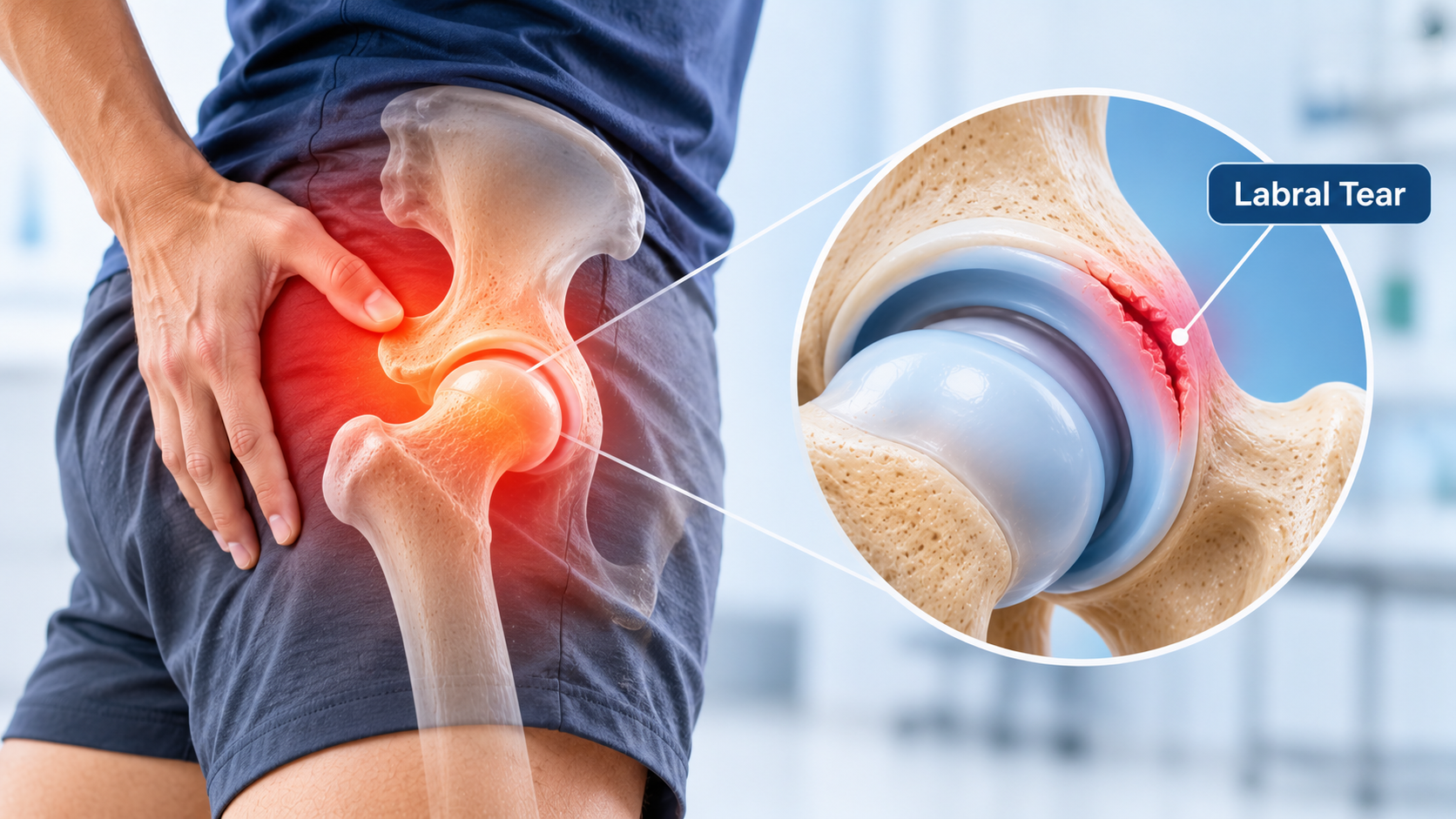
The hip joint is a ball-and-socket joint supported by cartilage, ligaments and surrounding muscles. A ring of specialised cartilage called the labrum surrounds the socket and helps improve joint stability. When the labrum becomes torn, some people experience groin pain, clicking, stiffness or discomfort during movement. Hip labral tears may develop following an injury, repetitive movements or structural changes in the hip. However, not every labral tear seen on an MRI causes symptoms or requires surgery. Understanding the underlying cause and evaluating the entire hip joint are important for choosing appropriate treatment.
What Is a Hip Labral Tear?
The acetabular labrum is a ring of fibrocartilage that surrounds the rim of the hip socket, also known as the acetabulum. It helps deepen the socket, supports joint stability and contributes to the seal that helps maintain fluid within the joint.
A hip labral tear occurs when this cartilage ring develops a tear or damage. The injury may involve different portions of the labrum and can vary in size and severity.
Labral tears may occur independently or alongside other hip conditions, including femoroacetabular impingement (FAI), cartilage damage or hip dysplasia. These associated problems can influence symptoms and treatment decisions.
A labral tear identified on imaging does not automatically mean it is responsible for pain. Some people have labral abnormalities without noticeable symptoms.
What Causes a Hip Labral Tear?
Hip labral tears can develop due to several factors. In some patients, a specific injury causes the tear, while others develop symptoms gradually because of repeated stress or underlying hip anatomy.
Sudden twisting movements, falls, direct impact or sports injuries may damage the labrum. Activities involving repeated hip rotation, deep flexion or pivoting can also contribute to irritation in susceptible individuals.
Femoroacetabular impingement occurs when the shape of the hip bones causes abnormal contact during certain movements. This repeated contact may place stress on the labrum and contribute to tearing.
Hip dysplasia, in which the socket provides insufficient coverage of the femoral head, can increase stress on the labrum. Degenerative changes and associated cartilage problems may also be involved in some cases.
Identifying the underlying cause is important because treatment directed only at the labral tear may not adequately address the mechanical problem affecting the hip.
Symptoms of a Hip Labral Tear
Symptoms vary depending on the location of the tear, associated hip conditions and individual activity levels. Some patients experience persistent discomfort, while others notice symptoms only during particular movements.
Pain is commonly felt in the groin or front of the hip. It may become more noticeable during prolonged sitting, walking, running, climbing stairs, pivoting or deep squatting.
Some people experience clicking, catching, locking sensations or a feeling that the hip is not moving smoothly. These symptoms may also occur with other hip problems and are not specific to a labral tear.
Stiffness, restricted movement and discomfort during hip rotation may also develop. Symptoms can interfere with sports, exercise and everyday activities when they persist.
Persistent hip or groin pain, particularly when it limits movement or activity, should be evaluated by an appropriate medical professional rather than assumed to be a labral injury.
How Is a Hip Labral Tear Diagnosed?
Diagnosis begins with a detailed medical history, including the onset of pain, previous injuries, sports participation and movements that aggravate symptoms. An orthopaedic examination evaluates hip movement, flexibility, strength and pain during specific manoeuvres.
X-rays are commonly performed to assess the shape of the hip joint, bone alignment and possible structural conditions such as femoroacetabular impingement or hip dysplasia. They do not directly show the labrum.
MRI can help evaluate the labrum, cartilage and other soft tissues around the hip. In selected cases, an MRI arthrogram may be recommended, in which contrast material is introduced into the joint to improve assessment of certain labral abnormalities.
Imaging findings should be interpreted carefully because labral tears can also be present in people without hip symptoms. The location of pain, clinical examination and other findings help determine whether the tear is likely to be clinically relevant.
Additional investigations may be considered when another condition is suspected or when symptoms remain unexplained despite initial evaluation.
Non-Surgical Treatment for a Hip Labral Tear
Many patients begin with non-surgical management, particularly when symptoms are manageable and there is no associated condition requiring a different approach. Treatment is guided by symptoms, functional limitations and the underlying cause.
Activity modification may involve temporarily reducing deep squatting, repetitive pivoting, high-impact exercise or movements that consistently trigger pain. Maintaining appropriate activity rather than complete inactivity can help preserve strength and mobility.
Physiotherapy may focus on strengthening the hip and surrounding muscles, improving movement control, addressing flexibility and gradually restoring functional activity. Exercises are selected according to the patient's symptoms and hip mechanics.
Pain-relief medication may be considered for selected patients after reviewing medical history, contraindications and possible side effects. Medication should be used according to medical advice.
Some patients may be considered for an injection to help assess or manage pain. An injection does not repair the labrum, and its suitability and expected benefit depend on the individual clinical situation.
Non-surgical treatment may improve symptoms and function even when the structural tear remains present. The response to rehabilitation helps inform whether further treatment needs to be considered.
When Is Hip Arthroscopy Recommended?
Hip arthroscopy is a minimally invasive procedure that uses a small camera and specialised instruments inserted through small incisions to examine and treat selected problems inside the hip joint.
Surgery may be considered when persistent symptoms significantly affect daily activities or sports despite appropriate non-surgical treatment, and clinical evaluation indicates that the labral tear or associated hip condition is likely responsible.
The decision depends on several factors, including the nature of the tear, joint cartilage condition, hip anatomy, associated impingement, activity goals and overall joint health.
A labral tear on MRI alone is not sufficient reason for surgery. The surgeon evaluates whether the expected benefits of the procedure outweigh its risks and whether another treatment approach may be more appropriate.
Types of Hip Labral Tear Surgery
Labral repair involves using specialised anchors and sutures to reattach suitable torn labral tissue to the rim of the hip socket. It may be considered when the labrum has sufficient quality and can be repaired.
Labral debridement involves removing or smoothing selected unstable or damaged tissue. It may be appropriate in certain cases, although preserving healthy labral tissue is generally an important consideration.
In selected patients, labral reconstruction or augmentation may be discussed when the labrum is extensively damaged or insufficient for conventional repair. These procedures involve specialised techniques and are not required for every tear.
If femoroacetabular impingement is contributing to the tear, the surgeon may also address the relevant bone abnormality during the procedure when appropriate.
The choice between repair, debridement or another treatment depends on the labrum's condition, hip anatomy, cartilage health and the overall clinical findings.
Recovery After Hip Labral Tear Surgery
Recovery after hip arthroscopy varies depending on the procedure performed, the extent of damage and whether additional conditions such as femoroacetabular impingement were treated.
Some patients use crutches temporarily and may have restrictions on weight-bearing or hip movement during the initial recovery period. These precautions help protect the treated structures while healing progresses.
Physiotherapy is an important part of rehabilitation. It generally progresses from gentle movement and muscle activation to strengthening, balance, functional exercises and eventually sport-specific activities when appropriate.
Returning to running, competitive sports or high-impact activity may take several months and depends on the patient's recovery, strength and functional progress.
The rehabilitation schedule should be individualised by the treating surgeon and physiotherapist. Progression should be based on clinical milestones rather than a fixed timeline alone.
Can a Hip Labral Tear Heal Without Surgery?
The labrum may not return to its original structural condition without treatment, but symptoms can improve with appropriate non-surgical management. Some patients remain comfortable and function well despite a tear that is still visible on imaging.
Physiotherapy, activity modification and management of contributing hip mechanics may reduce discomfort and improve movement control.
Treatment aims to address symptoms and function rather than guarantee structural healing of the labrum. The appropriate approach depends on the patient's condition and clinical assessment.
Persistent symptoms, worsening pain or significant functional limitations may warrant reassessment to determine whether further investigations or treatment options are needed.
When Should You See an Orthopaedic Specialist?
Consider an orthopaedic evaluation if groin or hip pain persists, movement becomes restricted, clicking or catching occurs alongside discomfort, or symptoms interfere with walking, exercise or daily activities.
A specialist assessment is particularly useful when pain continues despite activity modification or physiotherapy, or when a sports injury or structural hip problem is suspected.
Seek prompt medical attention following a significant injury if you cannot bear weight, experience severe pain or notice sudden major restriction of hip movement.
An orthopaedic specialist can help determine whether symptoms arise from the labrum, hip cartilage, bone structure, muscles or another condition and recommend an appropriate treatment plan.
Conclusion
A hip labral tear can cause groin pain, clicking, stiffness and difficulty with physical activity. However, the severity of symptoms and treatment requirements differ from one patient to another.
Accurate diagnosis requires clinical evaluation alongside appropriate imaging. Many patients begin with activity modification and physiotherapy, while hip arthroscopy may be considered for selected cases with persistent symptoms and relevant structural problems.
Understanding the cause of the tear, the condition of the hip joint and individual activity goals helps guide treatment decisions and support recovery.
Frequently asked questions
Common symptoms include groin pain, hip stiffness, clicking, catching sensations and discomfort during walking, prolonged sitting, pivoting or deep squatting. Some labral tears may not cause symptoms.
The labrum may not regain its original structural condition, but symptoms can improve with physiotherapy, activity modification and appropriate management. Some patients function comfortably without surgery.
MRI can help identify labral abnormalities, and an MRI arthrogram may be recommended in selected cases. Imaging findings must be interpreted alongside symptoms and clinical examination because some tears are asymptomatic.
Treatment depends on symptoms, tear characteristics, hip anatomy and associated conditions. Options may include physiotherapy, activity modification and hip arthroscopy in selected patients with persistent symptoms.
No. Many patients can begin with non-surgical management. Surgery is generally considered when symptoms persist, affect function and are linked to a treatable structural problem.
Recovery varies according to the procedure and associated hip conditions. Rehabilitation may continue for several months, and returning to sports or high-impact activity depends on strength, movement and functional progress.
A labral tear may be associated with clicking or catching, but these symptoms can also occur with other hip conditions. Clicking without pain does not necessarily indicate a serious injury.
Labral tears may coexist with cartilage damage or structural hip abnormalities that influence joint health. A labral tear alone does not automatically mean that arthritis will develop.
Originally published on dranilraheja.com.