
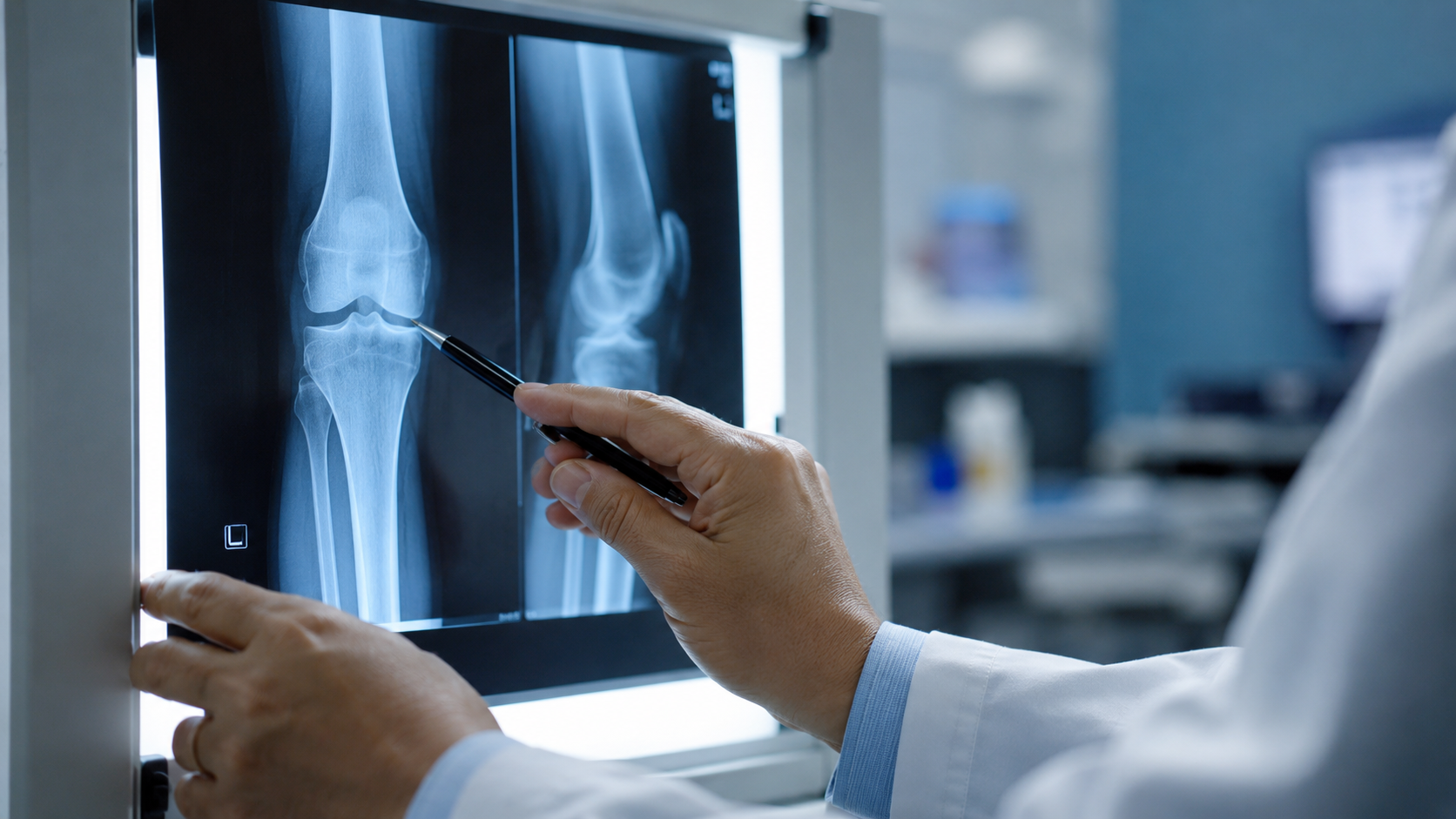
If a recent X-ray report used a phrase like "Grade 3 osteoarthritis" or "moderate degenerative changes," the natural next question is whether that means surgery's on the table now. Usually it isn't, at least not yet. The radiographic grade tells you how the joint looks. It doesn't reliably tell you how much it hurts, how limited you are, or whether you're actually ready for replacement. Those three things, the scan, your symptoms, and your daily function, all need to line up before knee replacement becomes the right recommendation rather than just one option among several.
What osteoarthritis actually is
Osteoarthritis is the gradual wearing down of the smooth cartilage that cushions the ends of the bones in your knee. As that cartilage thins, the joint space narrows. The bone underneath can thicken and form small spurs called osteophytes, and movement that used to be painless starts producing friction, stiffness, and inflammation.
It's the most common form of arthritis in the knee. In India, it affects a substantial share of adults over 50, more often women, and more often people who are overweight, have had a prior knee injury, or spend long periods in postures that load the knee heavily, floor-sitting, squatting, and stair use among them.
How the stages are graded, and why the grade alone is not the answer
The most widely used radiographic scale is the Kellgren-Lawrence system. It grades an X-ray from 0 to 4 based on joint space narrowing, bone spurs, and bony changes, a useful, standardised way for doctors to describe what a scan shows.
What it doesn't do well is predict pain. Several studies looking at this directly have found no strong correlation between the radiographic grade and how much pain a patient actually reports. Some people with severe-looking Grade 3 changes on X-ray have fairly mild symptoms and manage comfortably for years with conservative treatment. Others with earlier-stage changes are in real daily pain. That's exactly why a treatment plan built around the X-ray number alone, instead of around how the knee is actually functioning day to day, tends to either operate too early or wait too long.
- Grade 0: no changes visible on X-ray
- Grade 1: minimal, doubtful narrowing and possible tiny bone spurs, usually not symptomatic yet
- Grade 2: definite bone spurs and possibly mild joint space narrowing, this is usually where mild symptoms begin
- Grade 3: multiple spurs, clear joint space narrowing, and early bony changes, moderate symptoms are common here but not universal
- Grade 4: large spurs, marked narrowing or bone-on-bone contact, and significant bony deformity, this is where surgery is most often genuinely indicated, though even here the decision still follows symptoms rather than the grade alone
Symptoms worth tracking, not just describing as "knee pain"
"My knee hurts" tells a doctor very little on its own. The pattern behind it tells a lot more, so it's worth noting these specifically before your appointment instead of trying to recall them on the spot.
- Morning stiffness that eases within 30 minutes usually points toward osteoarthritis rather than an inflammatory arthritis, where stiffness tends to last much longer
- Pain that worsens with activity and improves with rest, the classic mechanical pattern
- Difficulty with stairs, particularly going down, and difficulty rising from a low chair or the floor
- A grinding or catching sensation during movement
- Visible swelling, or a feeling that the knee is giving way
- Night pain that disturbs your sleep, worth flagging specifically since it often marks a real step up in severity
What genuinely helps at the earlier stages
For Grade 1 to 3 osteoarthritis, non-surgical treatment isn't a stalling tactic. It's legitimate, evidence-backed first-line care, and it works well for a lot of patients for years.
- Losing weight if you're overweight. Every kilogram lost cuts load across the knee by several times that amount with each step, which makes this one of the highest-impact changes available
- Quadriceps and hip strengthening exercises. A stronger muscle envelope around the knee measurably reduces pain and improves function, and this is well established in research
- Low-impact activity such as swimming, cycling, or walking on level ground, keeping the joint moving without heavy impact loading
- Anti-inflammatory medication used appropriately, for flare-ups rather than continuously without review
- Supportive footwear and, where relevant, a knee brace or offloading support for specific activities
- Corticosteroid or viscosupplementation injections for a flare, useful for temporary relief in some patients, though not a long-term disease-modifying treatment
- Physiotherapy directed specifically at gait pattern and joint mechanics, not just general exercise
When replacement becomes the right conversation to have
Total or partial knee replacement generally comes into the picture once conservative treatment has actually been tried, not just mentioned, and it's no longer controlling symptoms well enough for daily life. This usually overlaps with Grade 4 changes on the X-ray, but what actually decides it is your symptoms and function, not the scan on its own.
A few signs it's time to have that conversation: pain that's there most days instead of only after activity, night pain that's regularly disturbing your sleep, stiffness or instability that's limiting basic things like walking a reasonable distance or managing stairs, and a real drop in quality of life that hasn't improved despite a genuine trial of weight management, strengthening, and medication over several months.
For some patients where the wear is limited to just one part of the knee, a partial knee replacement is an option. It's a smaller operation, usually with a faster recovery, and it replaces only the damaged compartment rather than the whole joint. Whether this applies to you depends on the specific pattern of wear seen on imaging, and it's worth asking about directly rather than assuming total replacement is the only surgical route.
What to ask at your appointment
- What grade is my osteoarthritis on the X-ray, and how much does that actually explain my symptoms?
- Have we genuinely tried strengthening and weight management, or just talked about them?
- Am I a candidate for partial knee replacement, or does the wear pattern mean total replacement makes more sense?
- What happens if I wait another year? Does delaying meaningfully change the outcome for me specifically?
- What would tell us it's time to move from conservative treatment to surgery?
When to see an orthopedic specialist
Book a consultation if knee pain has lasted more than a few weeks despite rest, if it's disturbing your sleep, if stairs or getting up from a chair have become genuinely difficult, or if you already have an X-ray showing moderate to severe changes and aren't sure what it means for you. Bring any existing X-rays or scans. Comparing them over time tells a surgeon far more than a single report does.
If you're in Delhi, consultations are available at Raheja Ortho And Gynae Clinic in Vijay Nagar, Apollo Spectra Hospitals in Karol Bagh, and Jeewan Mala Hospital, Karol Bagh.
Frequently asked questions
Not automatically. The radiographic grade describes how the joint looks, not how much it hurts or how limited you are. Research has found only a weak correlation between X-ray grade and reported pain. The decision to operate is based mainly on your symptoms and how well conservative treatment is working, not the grade on its own, though Grade 4 changes combined with poorly controlled symptoms is where surgery becomes the most common recommendation.
No, the cartilage loss itself can't be reversed with current treatments. What can genuinely improve is your pain and function at any stage, through weight management, targeted strengthening, activity changes, and, when needed, medication or injections. Plenty of patients manage comfortably for years without surgery once these are properly in place, even with moderate changes visible on imaging.
Significantly. Each kilogram of body weight translates into several times that load across the knee joint with every step, so even a modest weight reduction meaningfully lowers the mechanical stress driving the pain. It's one of the few interventions with strong, consistent evidence behind it across every stage of knee osteoarthritis.
Partial knee replacement resurfaces only the damaged compartment of the knee. It's typically used when wear is limited to one area and the rest of the joint and surrounding ligaments are still healthy, and it's usually a smaller operation with a comparatively faster recovery. Total knee replacement resurfaces the whole joint and is used when damage is more widespread. Whether you're a candidate for partial replacement depends on the specific pattern of wear seen on imaging.
For most patients, a reasonable delay while trying conservative treatment doesn't significantly worsen the surgical outcome. Waiting isn't inherently harmful. What matters more is whether that delay comes with actual treatment, weight management, strengthening, medication, rather than just enduring worsening symptoms without addressing them. Whether continued delay makes sense for you specifically is worth discussing directly with your surgeon.
Corticosteroid and viscosupplementation injections are generally useful for temporary relief during a flare, not as an ongoing, disease-modifying treatment. They can be a reasonable part of a broader conservative plan, but relying on repeated injections alone, without addressing weight, strength, and activity, typically gives diminishing benefit over time.
Most commonly from the early 50s onward, though it can show up earlier after a significant knee injury, in people who are overweight, or with a strong family history. It's more common in women, and in India, occupational and lifestyle factors like prolonged floor-sitting and squatting also contribute to earlier or more pronounced symptoms in some patients.
Originally published on dranilraheja.com.