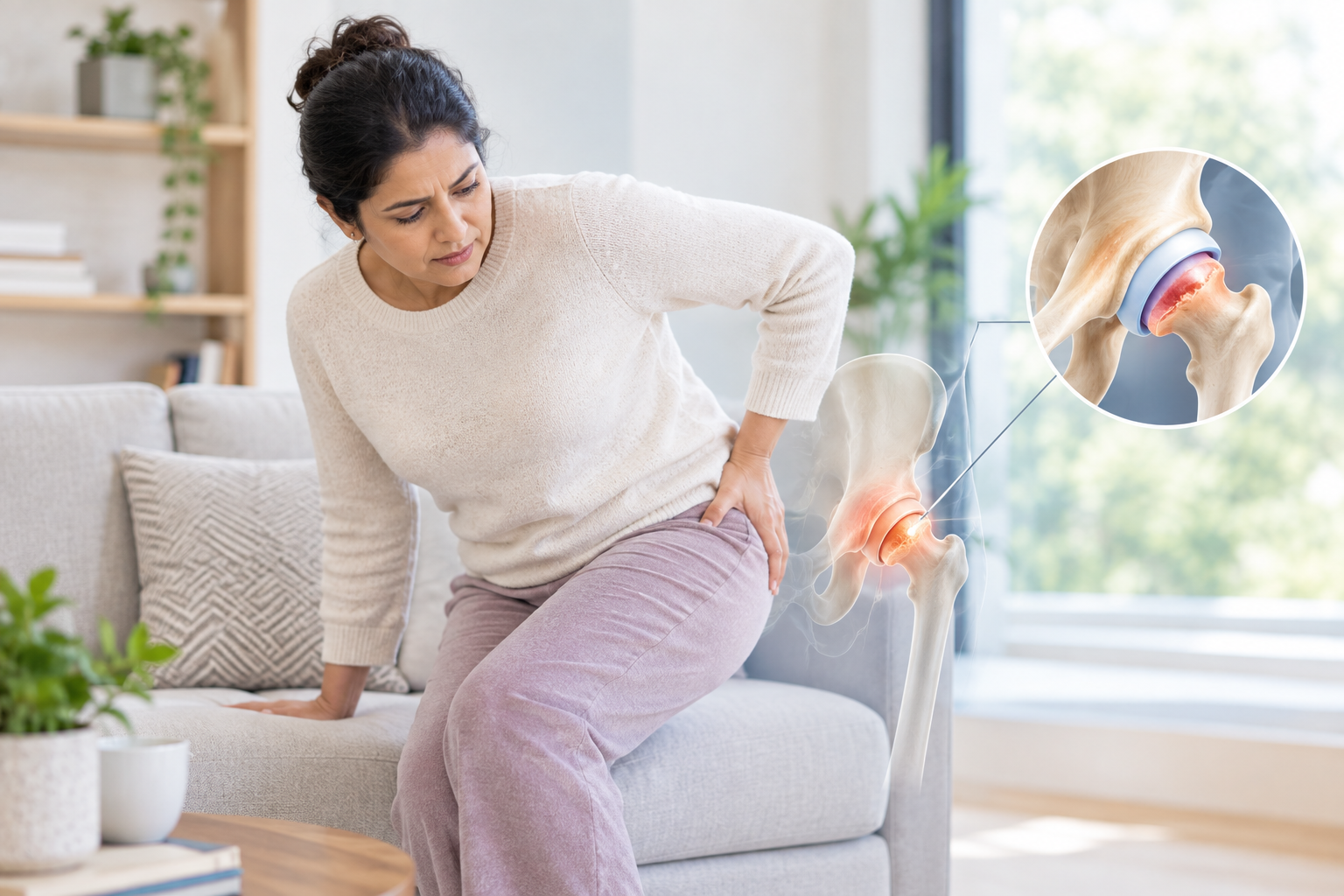

Hip pain while walking can make ordinary activities such as going up stairs, standing for long periods or walking outdoors increasingly difficult. The pain may come from the hip joint itself, the muscles and tendons around it or another part of the body such as the lower back. Hip arthritis is one possible cause, but it is not the only one. Understanding where the pain is felt, when it appears and what other symptoms are present can help identify the underlying problem.
What does hip pain while walking usually mean?
Walking puts repeated load through the hip joint and the muscles and tendons that support it. Pain that appears during walking can therefore come from several different structures.
Pain deep in the groin or front of the hip is more suggestive of a problem inside the hip joint. Pain over the outer side of the hip may be related to surrounding soft tissues such as tendons or bursae. Pain can also be referred from the lower back and may be felt around the hip, buttock or thigh.
The location of pain provides useful clues, but it cannot establish the diagnosis by itself.
What are the common causes of hip pain while walking?
Hip pain during walking can occur because of arthritis, injuries, tendon or muscle problems, bursitis or other conditions affecting the hip and surrounding structures.
- Hip osteoarthritis
- Bursitis around the hip
- Tendon irritation or tendinopathy
- Muscle or tendon strain
- Hip labral problems
- Previous hip injury
- Stress or other fractures
- Avascular necrosis of the hip
- Pain referred from the lower back
- Less common inflammatory or other joint conditions
Can hip arthritis cause pain while walking?
Yes. Hip osteoarthritis can cause pain, stiffness and reduced movement. The pain may become more noticeable during activities that load the joint, including walking.
Hip arthritis pain is often felt in the groin or front of the thigh, but it can also be felt in the buttock, outer hip or even the knee.
As the condition progresses, people may notice that walking longer distances becomes difficult, they need to stop more often or they start changing the way they walk to reduce discomfort.
What does hip arthritis pain feel like?
Hip arthritis does not feel exactly the same for everyone. Some people describe a deep ache in the groin or front of the hip, while others notice stiffness and difficulty moving the hip.
Pain may initially appear mainly with longer walks or more demanding activities. With more advanced joint changes, pain can begin interfering with routine activities, getting up from a chair or sleeping.
A painful hip should not automatically be assumed to have arthritis. A clinical examination and appropriate imaging may be needed to determine the cause.
Can hip bursitis cause pain while walking?
Yes. Bursitis can cause pain around the outer side of the hip and may become more noticeable with walking, stairs or lying on the affected side.
Bursitis involves inflammation of a small fluid-filled sac that helps reduce friction around the joint. The symptoms can sometimes resemble hip arthritis, which is why the exact location and pattern of pain are important.
Can muscles or tendons cause hip pain while walking?
Yes. Muscles and tendons around the hip help stabilize the pelvis and control movement while walking. Overuse, repetitive activity or a strain can cause pain when these tissues are loaded.
Tendon-related pain is often linked to particular movements or activities and may be felt around the outer hip, buttock or upper thigh depending on the structure involved.
Can hip pain actually come from the back?
Yes. Pain felt around the hip or buttock can sometimes come from the lower back rather than the hip joint itself.
Nerve irritation or other spinal problems can produce pain that travels into the buttock, thigh or leg. Symptoms such as back pain, tingling, numbness or pain that travels down the leg can provide clues that the spine may be contributing.
This is one reason why a physical examination is important before assuming that every walking-related hip pain problem is caused by the hip joint.
Why does my hip hurt when I walk but feel better when I rest?
Pain that increases with walking and improves with rest can occur with several musculoskeletal conditions, including hip arthritis and some soft-tissue problems.
The pattern is useful information, but it does not identify one specific diagnosis. The duration of the pain, location, stiffness, age, activity level and other symptoms all need to be considered.
Why does my hip hurt when climbing stairs?
Climbing stairs increases the load placed on the hip and requires greater work from the muscles around the pelvis and thigh. Hip arthritis, tendon problems, bursitis and muscle weakness can therefore become more noticeable during stairs.
If stair climbing repeatedly causes hip pain or the pain is progressively worsening, an assessment can help determine whether the problem is coming from the joint or surrounding tissues.
When should you see an orthopaedic doctor for hip pain?
You should consider an orthopaedic assessment when hip pain keeps returning, is getting worse or starts affecting normal activities.
An assessment is particularly important when walking becomes difficult, the pain affects sleep or the symptoms continue despite appropriate rest and activity modification.
- Hip pain is affecting your normal walking
- You are avoiding activities because of the pain
- Pain keeps returning or is becoming more frequent
- Hip stiffness is making everyday movement difficult
- You have persistent groin, thigh or outer hip pain
- You are developing a limp
- Pain is affecting your sleep
- Symptoms are not improving with reasonable home care
When is hip pain an emergency?
Sudden severe hip pain after a fall or other significant injury needs urgent medical assessment, particularly if you cannot stand or put weight on the affected leg.
A hip that becomes very painful without an obvious injury can also require prompt assessment when the pain is severe or accompanied by fever, feeling unwell, warmth or swelling around the joint.
These symptoms can occur with conditions that need urgent treatment, including fractures or joint infection.
How is hip pain diagnosed?
Diagnosis starts with understanding where the pain is located, when it appears and what activities make it worse or better. Your doctor may ask about walking distance, stairs, stiffness, previous injuries, back symptoms and how the pain affects everyday activities.
The hip and surrounding areas are examined for movement, tenderness, strength and other findings that can help distinguish joint problems from soft-tissue or spine-related pain.
An X-ray is commonly used when hip arthritis or other bone and joint changes are suspected. Additional imaging may be considered when the diagnosis is unclear or when conditions affecting soft tissues, the labrum or bone need further assessment.
- Identify the exact location of the pain
- Understand when walking or other activities trigger symptoms
- Check hip movement, strength and stability
- Assess the lower back and surrounding structures when appropriate
- Use X-rays when arthritis or other structural changes need evaluation
- Consider additional imaging when required
- Match examination and imaging findings with the symptoms before deciding on treatment
How is hip pain while walking treated?
Treatment depends on the cause. There is no single treatment that is appropriate for every person with hip pain.
For some conditions, activity modification, physiotherapy, strengthening and appropriate medicines may help. Treatment may be different when the cause is hip arthritis, bursitis, tendon irritation, a labral problem or a condition affecting the spine.
If hip arthritis becomes advanced and continues to cause significant pain and loss of function despite appropriate non-surgical treatment, hip replacement may eventually be discussed.
- Activity modification
- Physiotherapy and targeted strengthening
- Weight management when appropriate
- Medicines for pain or inflammation when medically suitable
- Treatment directed at bursitis or tendon problems
- Selected injections in appropriate situations
- Surgical treatment when a structural problem requires it
- Hip replacement for selected patients with advanced joint damage and persistent symptoms
Does hip pain while walking mean you need a hip replacement?
No. Hip pain while walking does not automatically mean that hip replacement is required.
Many causes of hip pain can be managed without replacement surgery. The decision about hip replacement depends on the underlying diagnosis, severity of joint damage, pain and stiffness, effect on daily activities and response to appropriate non-surgical treatment.
If the hip joint has advanced arthritis and pain continues to significantly affect walking, sleep or everyday activities despite other treatment, hip replacement may be considered.
How can you protect your hip while it is painful?
Until the cause of the pain is understood, avoid activities that clearly make the symptoms worse. This does not necessarily mean complete rest. In many conditions, maintaining appropriate movement and gradually strengthening the surrounding muscles are important.
Low-impact activities may be easier to tolerate than repeated high-impact exercise. Your doctor or physiotherapist can advise you about which activities are appropriate once the cause of the pain is known.
What should you tell your orthopaedic doctor?
- Where exactly do you feel the pain?
- Does it occur only while walking or also when resting?
- How far can you walk before the pain starts?
- Does climbing stairs make it worse?
- Do you have morning stiffness?
- Do you have groin, thigh, buttock or knee pain?
- Have you noticed a limp?
- Have you had a previous hip or back injury?
- Does the pain affect your sleep or daily activities?
The Bottom Line
Hip pain while walking can come from the hip joint, surrounding muscles and tendons or even the lower back. Hip arthritis is a common cause, but bursitis, tendon problems, injuries and other conditions can produce similar symptoms.
If hip pain is persistent, getting worse or interfering with walking, stairs, sleep or everyday activities, an orthopaedic assessment can help identify the cause. Treatment should be based on the diagnosis rather than assuming that walking-related hip pain automatically means arthritis or the need for surgery.
Frequently asked questions
Hip pain while walking can have several causes, including hip arthritis, bursitis, tendon problems, muscle strain, previous injury or pain referred from the lower back. The location and pattern of the pain can help your doctor determine the likely cause.
Yes. Hip osteoarthritis can cause pain and stiffness that becomes more noticeable during walking or other activities that load the joint. Pain is often felt in the groin or front of the thigh but can also occur around the buttock, outer hip or knee.
Climbing stairs places greater demand on the hip joint and surrounding muscles. Arthritis, bursitis, tendon problems and other conditions can therefore cause pain during stair climbing.
Yes. Problems in the lower back can sometimes cause referred pain around the hip, buttock or thigh. Back pain, numbness, tingling or pain travelling down the leg can provide clues that the spine may be contributing.
See an orthopaedic doctor if hip pain keeps returning, is getting worse, affects walking or sleep, limits your normal activities or does not improve with reasonable home care. Sudden severe pain after an injury or inability to bear weight requires prompt medical assessment.
No. Hip pain while walking can have many causes and most do not automatically require replacement surgery. Hip replacement may be considered when advanced joint damage causes persistent, function-limiting symptoms despite appropriate non-surgical treatment.
Originally published on dranilraheja.com.